
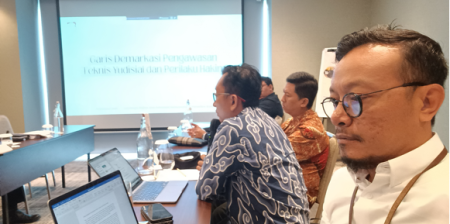
On 14 December 2023, Febi Yonesta, Managing Partner of Legitima Law Firm, had the honor of representing the Indonesian Advocates Association (PERADI), under the leadership of Dr. Luhut M.P. Pangaribuan, at a Focus Group Discussion (FGD) entitled The Demarcation Line Between Judicial Technical Oversight and Judicial Conduct. The event was organized by the Institute for Judicial Independence (LeIP) and held at Novotel Cikini, Jakarta.
LeIP Research Findings on Judicial Oversight
During the discussion, LeIP’s research team presented the findings of its study on the oversight mechanisms exercised by the Supreme Court (Mahkamah Agung or MA) and the Judicial Commission (Komisi Yudisial or KY).
One of the key findings highlighted differences in decisions issued by the MA and KY concerning the same cases. This finding once again brought attention to the longstanding debate regarding the limits of each institution’s supervisory authority, particularly concerning the extent to which oversight may address judicial misconduct as opposed to judicial technical matters and legal reasoning (legal error).
This debate is often linked to the principle that oversight should not undermine judicial independence in examining and deciding cases.
According to LeIP’s research, in several instances the MA concluded that investigations conducted by the KY had entered the realm of judicial technical matters. As a result, disciplinary recommendations proposed by the KY were not always approved by the MA.
Conversely, where the subject of examination genuinely concerned judicial conduct, the KY’s recommendations were generally accepted and implemented by the MA through the applicable disciplinary mechanisms.
Febi Yonesta’s Perspective on the Purpose of Judicial Oversight
During the discussion session, Febi Yonesta shared his views on the concept of oversight within Indonesia’s judicial system.
According to him, before discussing judicial technical oversight, administrative and financial supervision, or oversight of judicial conduct, it is first necessary to define the fundamental purpose of oversight itself.
He noted that neither the Judicial Power Law, the Supreme Court Law, nor the Judicial Commission Law explicitly formulates the objectives of judicial oversight.
Nevertheless, a closer examination of these regulations reveals several underlying purposes, including:
- Ensuring a judiciary capable of upholding law and justice (fair trial);
- Promoting a judicial system that is simple, efficient, and cost-effective (good governance);
- Safeguarding judicial independence and autonomy;
- Ensuring impartial adjudication;
- Guaranteeing equal and non-discriminatory treatment;
- Establishing a judiciary with integrity and free from corruption, collusion, and nepotism;
- Upholding the honor, dignity, and ethical conduct of judges.
According to Febi Yonesta, these objectives should serve as the foundation for determining:
- The scope of supervisory authority; and
- Which institution should be entrusted with exercising such oversight.
Oversight Must Serve the Objectives of the Judiciary
Febi Yonesta emphasized that the supervisory powers vested in both the MA and KY should ultimately be directed toward achieving these objectives.
Accordingly, oversight of judicial administration, financial management, and judicial conduct should be interpreted and structured broadly enough to support the realization of all oversight goals identified above.
In his view, if oversight is genuinely oriented toward these objectives, ongoing disputes regarding the boundaries between the MA’s internal oversight and the KY’s external oversight—including debates over whether a matter concerns judicial technical issues or judicial conduct—should no longer persist.
He argued that achieving a fair, independent, and accountable judiciary requires closer cooperation between the MA and KY. It would be difficult, he noted, for either institution to effectively accomplish these goals without the support of the other.
The Importance of Developing Joint Examination Mechanisms
Febi Yonesta also pointed out that the MA and KY already possess a framework for cooperation through the 2012 Joint Regulation, which provides for joint examinations.
According to him, this mechanism should be maintained, further developed, and strengthened as an important instrument for enhancing the effectiveness of judicial oversight.
The Relationship Between Misconduct and Legal Error
Febi Yonesta observed that one of the principal challenges in implementing oversight functions stems from provisions stating that supervision must not interfere with judicial independence in deciding cases.
This condition often results in limitations or reluctance to scrutinize judicial reasoning and the substantive aspects of court decisions (legal error).
However, he argued that in many cases there is a close connection between judicial misconduct and errors in legal reasoning.
For example, a judge’s partiality during proceedings may correlate with deficiencies in the resulting judgment. Such circumstances may be reflected where a judge considers only the facts or evidence presented by one party, disregards significant facts revealed during trial, or fails to assess all available evidence in a balanced manner. These shortcomings may ultimately lead to an erroneous decision.
Oversight Is Not Incompatible with Judicial Independence
According to Febi Yonesta, oversight of judicial technical matters and the substance of judicial decisions should not automatically be viewed as interference with judicial independence.
On the contrary, indications of bias in judicial proceedings may demonstrate that judicial independence is not functioning as intended.
Therefore, findings arising from oversight of judicial conduct, judicial technical matters, and the substance of decisions can provide valuable evaluation tools for higher courts when reviewing and correcting judgments issued by lower courts.
In this way, oversight serves not only to preserve judicial integrity but also to improve the quality of judicial decisions and strengthen public confidence in the justice system.