
Mentorship Program on Pluralism and Freedom of Religion
On December 9, 2023, Legitima Law Firm Managing Partner, Febi Yonesta, had the opportunity to facilitate an online discussion on religious freedom with the Harvard Law School Religious Freedom Clinic.
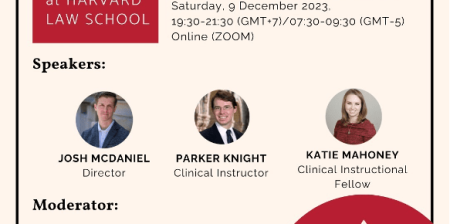
The discussion featured several speakers from Harvard Law School, including Joshua McDaniel, Director of the Religious Freedom Clinic; Parker Knight, Clinical Instructor; Katie Mahoney, Clinical Instructor Fellow; and Steven Burnett, who also serves as a Clinical Instructor Fellow.
The event was part of the Mentorship Program for Indonesian Law Students organized by the American Bar Association Rule of Law Initiative (ABA ROLI) under the theme Pathway to Pluralism. In this program, Febi Yonesta participated as one of the mentors.
Discussion Focus: Legal Strategies for Protecting Religious Freedom
During the session, Febi Yonesta posed a series of guiding questions aimed at exploring the experiences and legal approaches employed by Harvard’s Religious Freedom Clinic in handling cases involving freedom of religion.
Key topics discussed included:
- How the clinic develops legal strategies for religious freedom cases;
- Methods for constructing legal and human rights arguments in matters involving freedom of religion;
- Considerations in selecting the most appropriate legal mechanisms for each case;
- Legal and non-legal challenges encountered during case representation;
- Approaches to addressing social bias, public pressure, and other obstacles arising during advocacy efforts; and
- The role of law students in casework and the contributions they make throughout the legal assistance process.
Overview of Harvard’s Religious Freedom Clinic
At the beginning of the discussion, Joshua McDaniel introduced the mission and scope of work of the Harvard Law School Religious Freedom Clinic.
He explained that the clinic serves as a collaborative platform where faculty members, attorneys, and law students work together to provide pro bono legal services to individuals whose religious freedom rights have been violated.
Joshua further noted that freedom of religion is a constitutional right protected under the First Amendment to the United States Constitution. This protection encompasses the freedom to practice a religion, change one’s beliefs, and engage in religious observance according to individual convictions.
However, he emphasized that limitations on the exercise of religious freedom may be permissible when they are based on legitimate grounds, are non-discriminatory in nature, and do not undermine the fundamental protection of religious liberty itself.
Case Experiences Shared by the Harvard Clinic
The clinic’s instructors then shared insights from several cases previously handled by the Harvard Religious Freedom Clinic.
Among the cases discussed were:
The Samantha Case
Samantha, a Muslim woman in the United States, was denied employment because the company maintained a policy prohibiting head coverings. The case raised questions regarding an employer’s obligation to accommodate employees’ religious practices.
The Groff Case
Groff requested not to be scheduled to work on Sundays because his religious beliefs required him to observe the day as a Sabbath. The United States Postal Service denied the request, arguing that granting it would impose additional burdens on other employees.
The Ramirez Case
Ramirez, a Baptist Christian, sought permission for a Baptist pastor to accompany him and offer prayers before his execution. The request was denied by the relevant government authorities.
The Mac Case
Mac, a Muslim convert serving a prison sentence, experienced various disruptions and restrictions that interfered with his ability to perform daily prayers while incarcerated.
Legal Approaches to Advancing Religious Freedom Rights
In these and other cases, Harvard’s Religious Freedom Clinic achieved outcomes that benefited the affected individuals and demonstrated that the rights they asserted were protected under the First Amendment to the United States Constitution.
In developing its legal arguments, the clinic emphasized the importance of providing reasonable accommodation to enable individuals to freely practice their religious beliefs.
This approach is based on the principle that accommodations should be provided when doing so does not impose significant hardship or excessive costs on the party responsible for providing them.
The clinic also incorporates historical practices and the evolving jurisprudence surrounding religious freedom protections as part of its legal advocacy strategy in each case.
The Value of Knowledge Exchange in Human Rights Advocacy
The discussion offered valuable insights into the legal approaches used to safeguard religious freedom across different jurisdictions. The exchange of experiences among practitioners, academics, and law students plays an important role in broadening understanding of human rights advocacy strategies and strengthening protections for freedom of religion.